Description
Product information
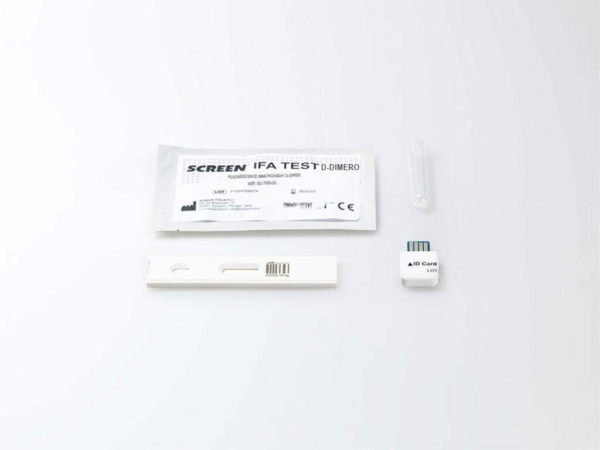
The IFA D-Dimer (Whole Blood/Plasma) test quickly measures D-Dimer levels in whole blood or plasma using the Immunofluorescence Analyzer. Designed for professional in vitro diagnostic use only, this test helps healthcare professionals assess thrombosis and coagulation activation in patients.
Why Measure D-Dimer?
D-Dimer is a breakdown product of fibrin produced during the degradation of blood clots. It is a critical marker for:
- Detecting thrombosis, including conditions like Deep Vein Thrombosis (DVT) and Pulmonary Embolism (PE).
- Assessing coagulation activation and fibrinolysis in patients with suspected thrombotic disorders.
- Evaluating cardiovascular risk, as elevated D-Dimer levels can be indicative of ongoing clot formation or fibrinolysis.
How It Works
The test uses immunofluorescence technology to detect D-Dimer in whole blood or plasma. If D-Dimer is present, it binds to fluorescent beads conjugated with anti-D-Dimer antibodies. Immobilized antibodies on the test line capture this complex, and the fluorescence intensity directly correlates with the D-Dimer concentration in the sample. The Analyzer calculates the D-Dimer concentration based on this fluorescence signal.
-
Rapid, accurate results.
-
Quantitative D-Dimer measurement.
-
Simple testing for whole blood or plasma samples.
Clinical Significance
D-Dimer levels are a valuable indicator of clot formation and degradation. Thrombotic disorders often result in elevated D-Dimer levels, while low levels (0.1–0.5 mg/L) may signal cardiovascular disorders. Additionally, healthcare professionals use elevated D-Dimer concentrations to help exclude DVT and PE, as higher levels indicate possible thrombotic events.
- Low levels (0.1–0.5 mg/L): May be linked to cardiovascular disorders.
- Elevated levels: Suggestive of thrombotic events, such as DVT or PE.
- Higher D-Dimer levels: Indicate active clot formation and fibrinolysis, aiding in diagnosis and monitoring of thrombotic conditions.
Additional Info
Positive and Negative Controls (2-Level Control) are available to ensure the accuracy and reliability of test results.
Additional information
| Product name | IFA D-Dimer Test |
|---|---|
| Detection | D-Dimer |
| Sample Type | |
| Pack Size | |
| Format | |
| Analyte Detection |
Related products
-
H. pylori Antigen Rapid Test
The H. Pylori Antigen Rapid Test Cassette (Feces) is a rapid chromatographic immunoassay for the qualitative detection of H. pylori antigens in human feces specimens to aid in the diagnosis of H. pylori infection. -
Mononucleosis Rapid Test
Mononucleosis Rapid Test to detect human heterophile IM antibodies (IgM class) in serum, plasma or whole blood -
IFA HbA1c Test
Immunofluorescence HbA1c (Whole Blood) Quantitative Rapid Test -
Fecal Occult Blood (FOB) Rapid Test
The Fecal Occult Blood (FOB) Rapid Test to detect the presence of hidden or occult blood in the feces